Chemistry
Investigate atoms, molecules, reactions, states of matter, and the building blocks of all substances.
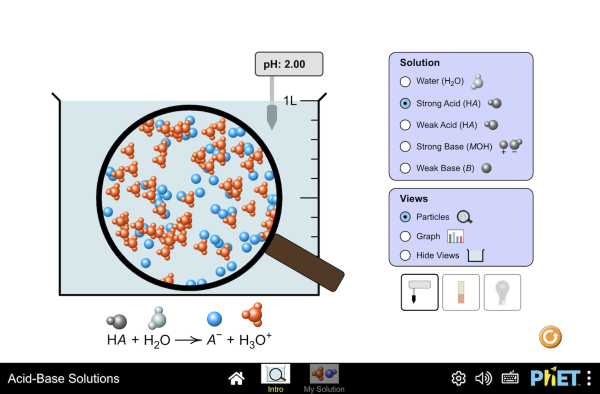
Acid-Base Solutions
How do strong and weak acids differ? Use litmus paper, pH meter, and conductivity tester to compare strong and weak acids and bases. Observe the molecules in solution.

Alpha Decay
Watch alpha particles escape from a polonium nucleus, causing radioactive alpha decay. See how random decay is, and observe the half-life of polonium-211.
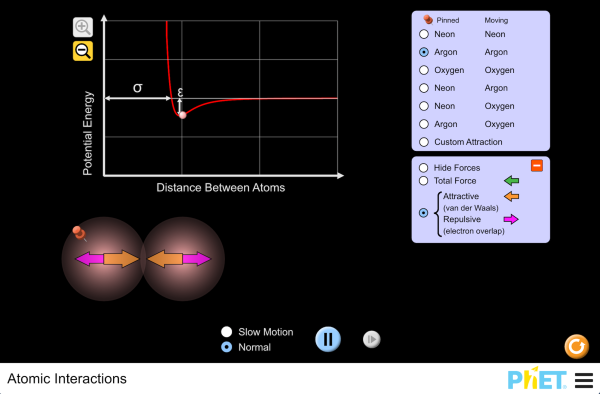
Atomic Interactions
Explore the interactions between various combinations of two atoms. Observe the potential energy diagram and see how it relates to the force between atoms.
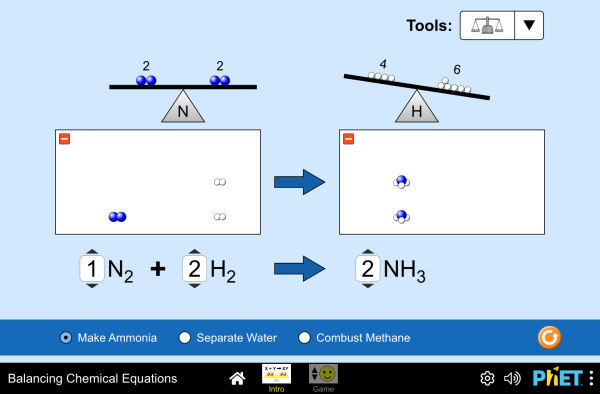
Balancing Chemical Equations
How do you know if a chemical equation is balanced? Play a game to balance chemical equations. Adjust coefficients to ensure the same number of atoms on both sides.
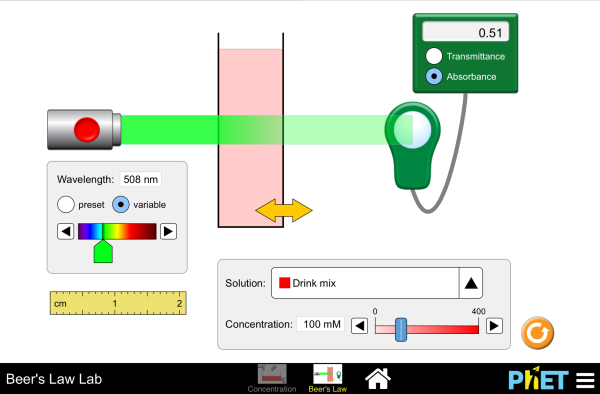
Beer's Law Lab
Make colorful concentrated and dilute solutions and explore how light interacts with the solution. Connect the wavelength and concentration of the solution to its absorbance and transmittance.
Beer's Law Lab
Investigate how the concentration of a solution affects the amount of light that passes through it. Measure the absorbance of solutions at different concentrations and wavelengths.

Beta Decay
Build an atom in the nucleus, then fire it off and see what happens! Watch beta decay happen in real time. Observe how the nucleus changes when a neutron becomes a proton.
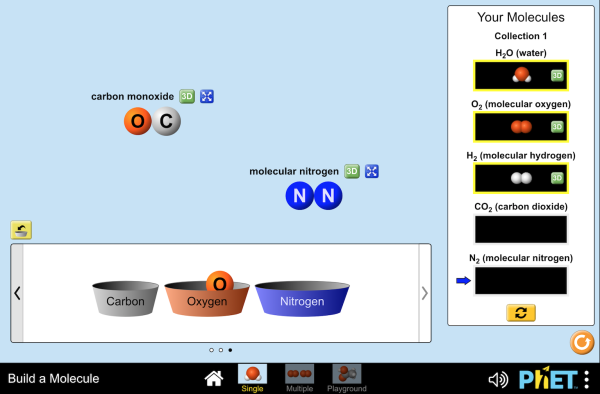
Build a Molecule
Starting from atoms, see how many molecules you can build. Collect your molecules and see them in 3D! How many can you collect?
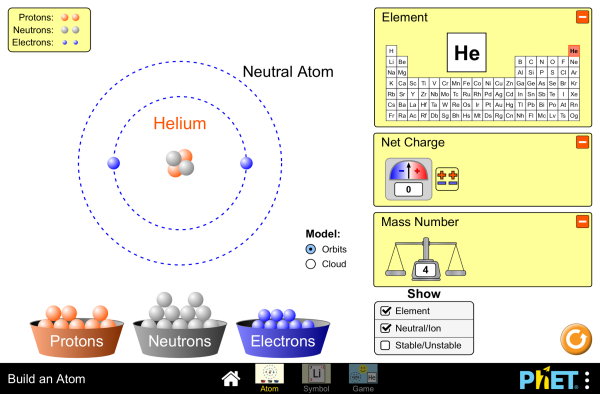
Build an Atom
Build an atom out of protons, neutrons, and electrons, and see how the element, charge, and mass change. Then play a game to test your ideas!
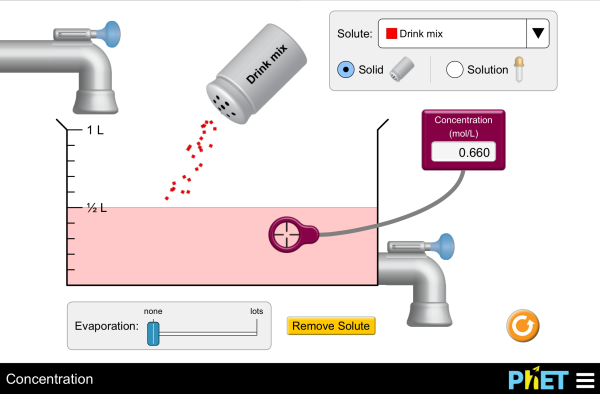
Concentration
Watch your solution change color as you mix chemicals with water. See how concentration changes with the amount of solute and solution volume. Calculate and display concentration in Molarity.
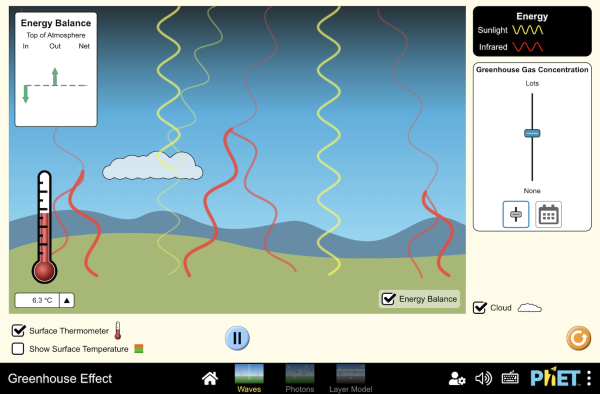
Greenhouse Effect
How do greenhouse gases affect the climate? Explore the effect of greenhouse gases on the temperature of the earth. Adjust the concentration of greenhouse gases and observe the effect on temperature.
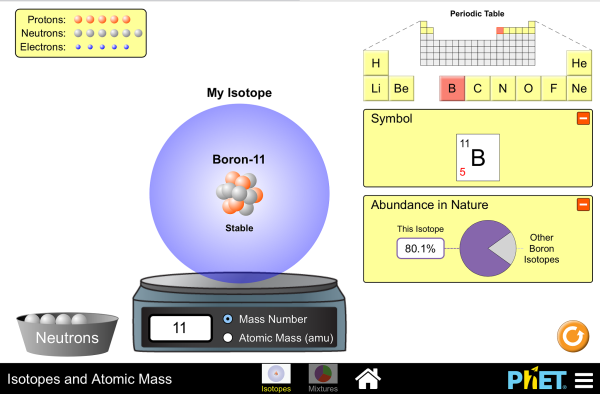
Isotopes and Atomic Mass
Are all atoms of an element the same? How do atoms of the same element differ? Explore the concept of isotopes by building atoms with different numbers of neutrons.
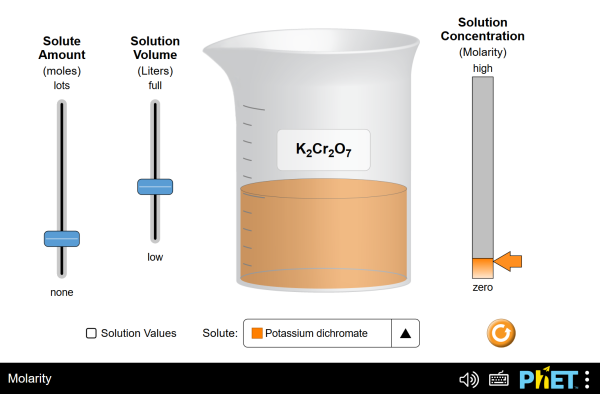
Molarity
What determines the concentration of a solution? Learn about concentration, molarity, and the factors that affect it. Observe how adding solute and changing volume affects molarity.
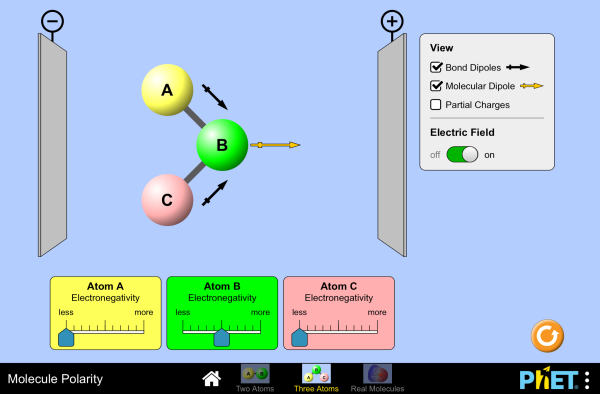
Molecule Polarity
When is a molecule polar? Explore electronegativity and molecular polarity. Adjust the electronegativity of atoms in a molecule and see how it affects the bond dipoles and molecular dipole.
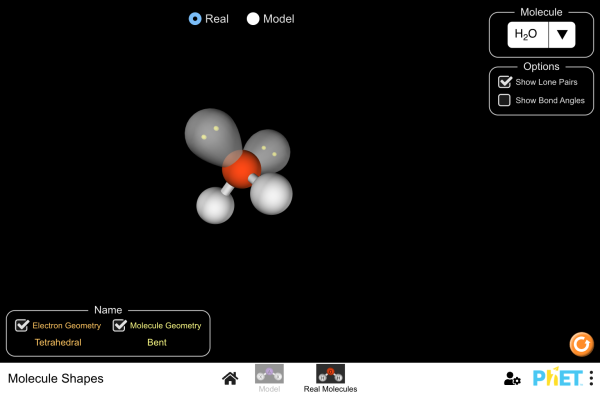
Molecule Shapes
Explore molecule shapes by building molecules in 3D! How does molecule shape change with different numbers of bonds and lone pairs? Find out by adding single, double or triple bonds and lone pairs to the central atom.

Molecule Shapes: Basics
Explore molecule shapes in 3D. Build simple molecules and observe how the number of bonds and lone pairs determines the shape.
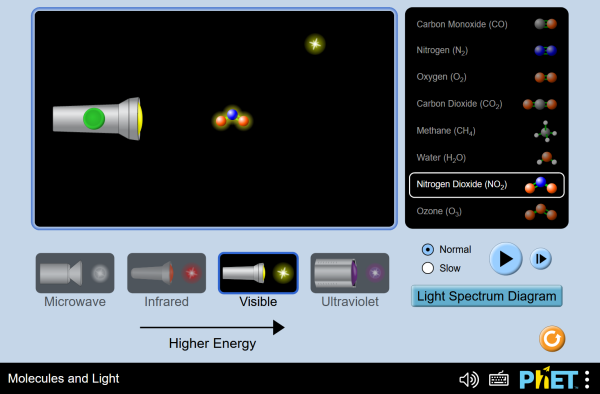
Molecules and Light
Do you ever wonder how a greenhouse gas traps heat from the sun? Explore how light interacts with molecules in our atmosphere. Start with the basics and then see how light interacts with ozone, oxygen, and other atmospheric molecules.

Nuclear Fission
Start a chain reaction, or introduce non-radioactive isotopes to prevent one. Control energy production in a nuclear reactor!
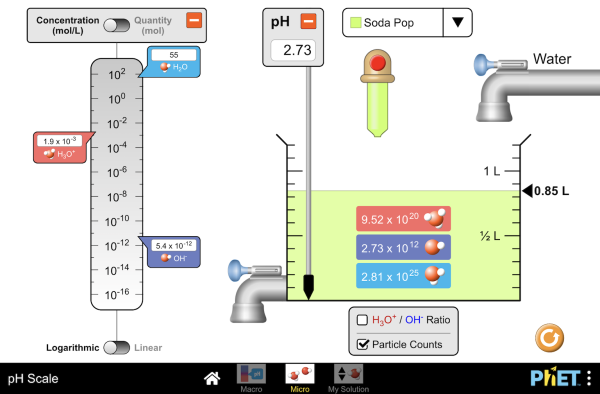
pH Scale
Test the pH of things like coffee, spit, and soap to determine whether each is acidic, basic, or neutral. Visualize the relative number of hydroxide ions and hydronium ions in solution.

Quantum Bound States
Explore the quantum mechanical model of bound states. Observe wave functions, energy levels, and probability densities for particles in various potential wells.

Radioactive Dating Game
Learn about different types of radiometric dating, such as carbon dating. Understand how decay and half life work to enable radiometric dating. Play a game that tests your ability to match the percentage of the dating element that remains to the age of the object.
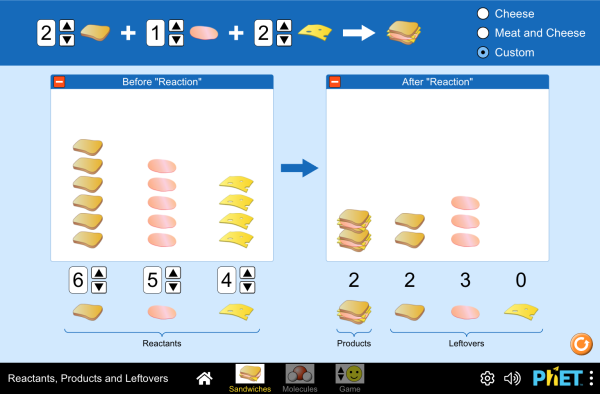
Reactants, Products and Leftovers
Create your own sandwich and then see how many sandwiches you can make with the ingredients you have. Apply the same concept to chemical reactions.

Reactions and Rates
Explore what makes a reaction happen by colliding atoms and molecules. Design experiments that show how factors like concentration, temperature, and surface area affect reaction rates.
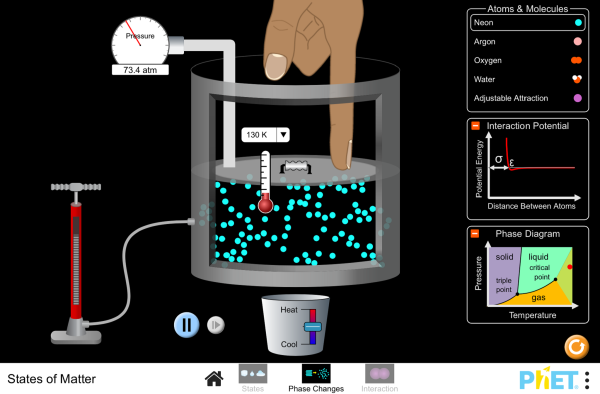
States of Matter
Watch different types of molecules form a solid, liquid, or gas. Add or remove heat and watch the phase change. Change the temperature or volume of a container and see a pressure-temperature diagram respond in real time.
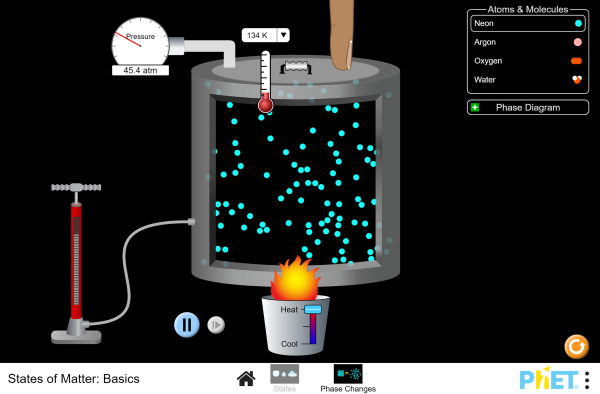
States of Matter: Basics
Heat, cool, and compress atoms and molecules and watch as they change between solid, liquid, and gas phases.

Sugar and Salt Solutions
Add different salts or alcohols to water, then watch them dissolve and see a diagram of the resulting solution. Determine if a substance is a strong or weak electrolyte by measuring the conductivity.

Wave Packets
Explore the wave-particle duality of quantum mechanics. Build wave packets from superpositions of plane waves and observe the uncertainty principle in action.