Biology
Discover life processes, genetics, evolution, cell biology, and the mechanisms of living organisms.

Cell Signaling
Explore how cells communicate with each other through chemical signals. Observe how a signal molecule binds to a receptor and triggers a cascade of events inside the cell.
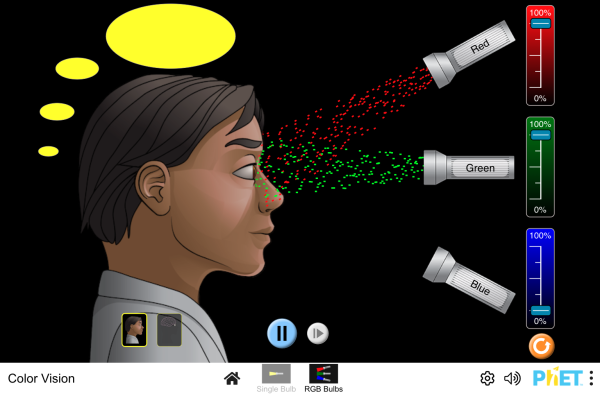
Color Vision
Explore how the human eye perceives color. Learn about the three types of cone cells and how they respond to different wavelengths of light.

Eating & Exercise
See how different foods and activities affect your body's energy balance. Explore the relationship between calories consumed and calories burned. Understand how metabolism works.
Epidemic Calculator
This calculator implements a classical infectious disease model — SEIR (Susceptible → Exposed → Infected → Removed), an idealized model of spread still used in frontlines of research e.g. [Wu, et. al, Kucharski et. al]. The dynamics of this model are characterized by a set of four ordinary differential equations that correspond to the stages of the disease's progression: individuals is 0.00088% given an attack rate of 0.45% [Burke et. al].
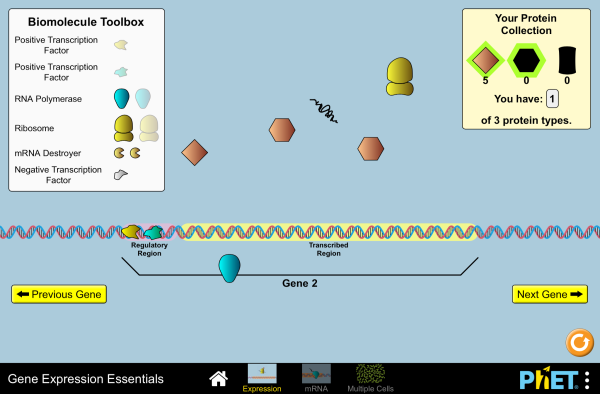
Gene Expression Essentials
Explore how genes are expressed to make proteins. Observe transcription (DNA to mRNA) and translation (mRNA to protein). See how transcription factors regulate gene expression.

Membrane Channels
Explore how molecules move across the cell membrane through channels and pumps. Observe passive transport (diffusion) and active transport. See how concentration gradients drive molecular movement.
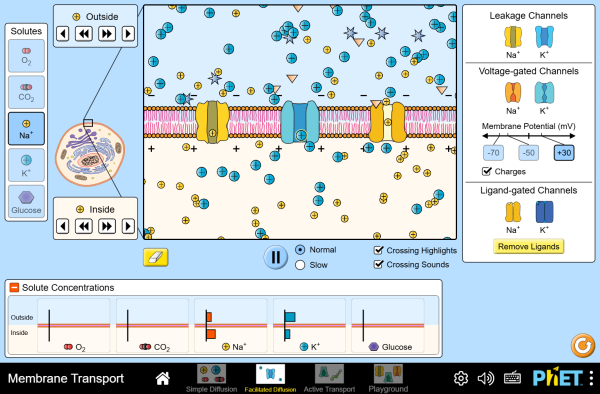
Membrane Transport
Explore how molecules move across cell membranes. Investigate passive transport (diffusion and osmosis) and active transport. See how membrane proteins facilitate transport.

Models of the Hydrogen Atom
How did scientists figure out the structure of atoms without looking at them? Try out different models by shooting light at the atom. Check how the prediction of the model matches the experimental results.
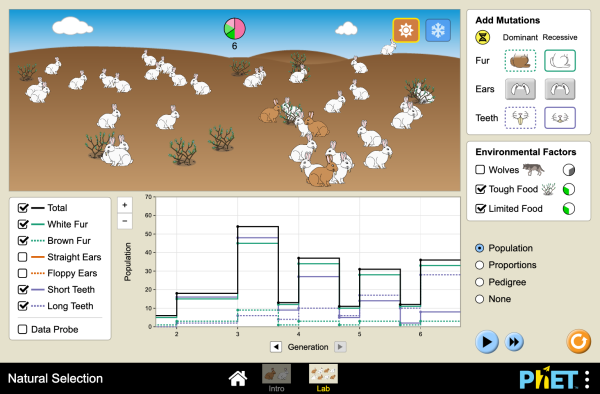
Natural Selection
Watch the bunnies multiply, adapt, and evolve! Add wolves and see how the population changes. Introduce mutations and see which traits are selected for or against.
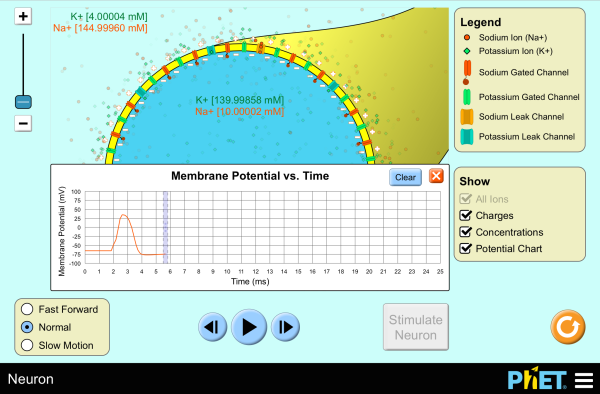
Neuron
Stimulate a neuron and see how it fires an action potential. Explore how the action potential travels along the axon. Learn about the role of ion channels in nerve signaling.
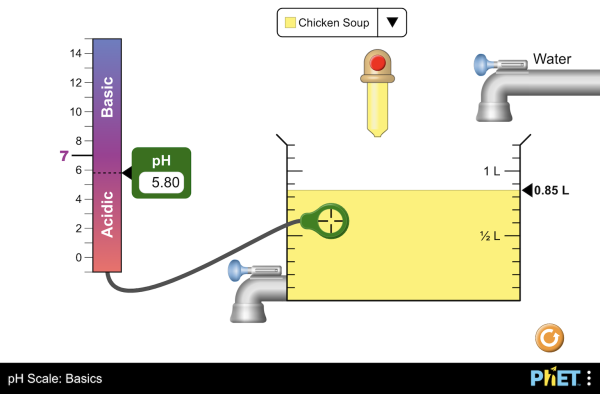
pH Scale: Basics
Test the pH of everyday liquids such as coffee, spit, and soap to determine whether each is acidic, basic, or neutral. Visualize the relative number of hydroxide ions and hydronium ions in solution.

Protein Synthesis
Explore the process of protein synthesis in detail. Watch how ribosomes read the mRNA sequence and assemble amino acids into a polypeptide chain. Understand the genetic code and codon-anticodon interactions.