All Simulations
Explore interactive simulations across Physics, Chemistry, and Biology
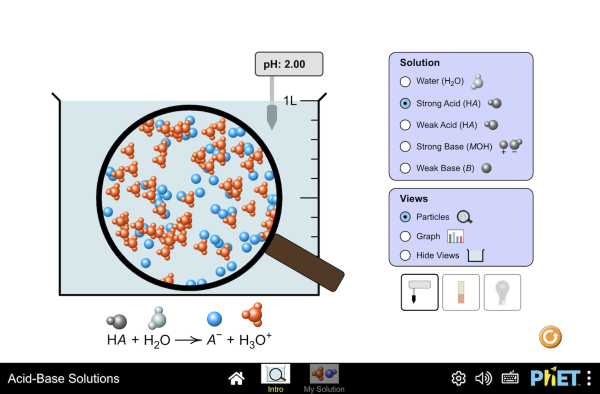
Acid-Base Solutions
How do strong and weak acids differ? Use litmus paper, pH meter, and conductivity tester to compare strong and weak acids and bases. Observe the molecules in solution.

Alpha Decay
Watch alpha particles escape from a polonium nucleus, causing radioactive alpha decay. See how random decay is, and observe the half-life of polonium-211.
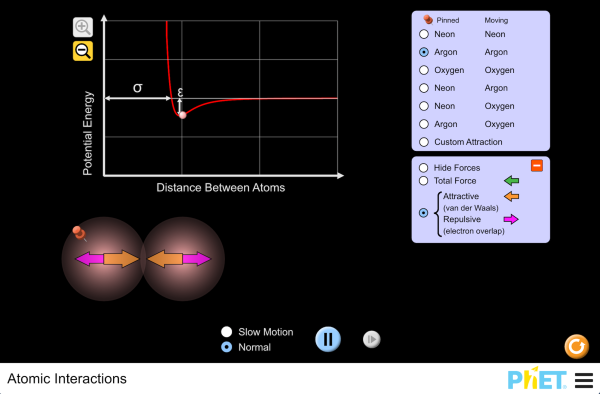
Atomic Interactions
Explore the interactions between various combinations of two atoms. Observe the potential energy diagram and see how it relates to the force between atoms.
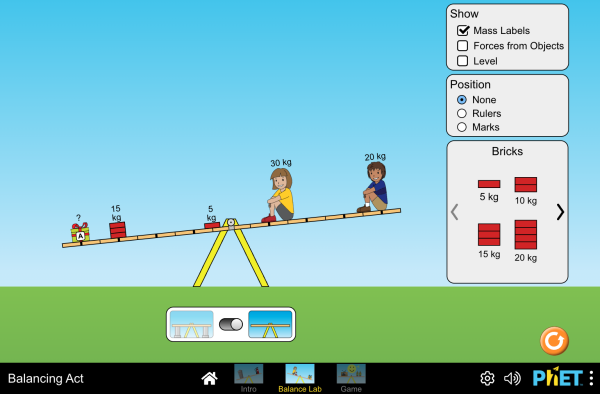
Balancing Act
Play with objects on a teeter totter to learn about balance. Test the balance of objects of different masses at different distances from the fulcrum.
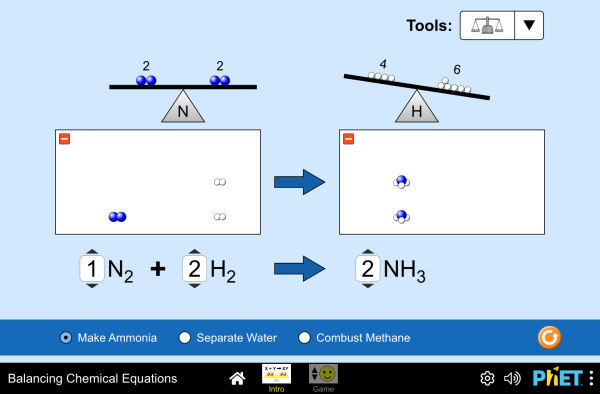
Balancing Chemical Equations
How do you know if a chemical equation is balanced? Play a game to balance chemical equations. Adjust coefficients to ensure the same number of atoms on both sides.
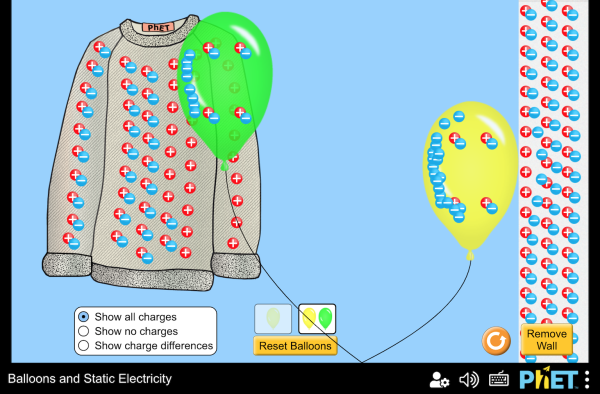
Balloons and Static Electricity
Why does a balloon stick to your sweater? Rub a balloon on a sweater, then let go of the balloon and see how it interacts with the wall. Use the sim to investigate what happens.
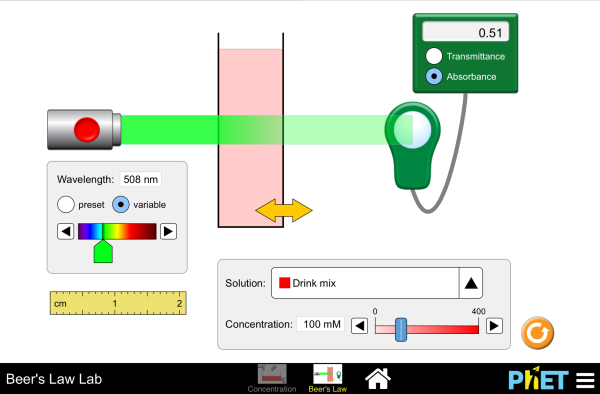
Beer's Law Lab
Investigate how the concentration of a solution affects the amount of light that passes through it. Measure the absorbance of solutions at different concentrations and wavelengths.
Beer's Law Lab
Make colorful concentrated and dilute solutions and explore how light interacts with the solution. Connect the wavelength and concentration of the solution to its absorbance and transmittance.
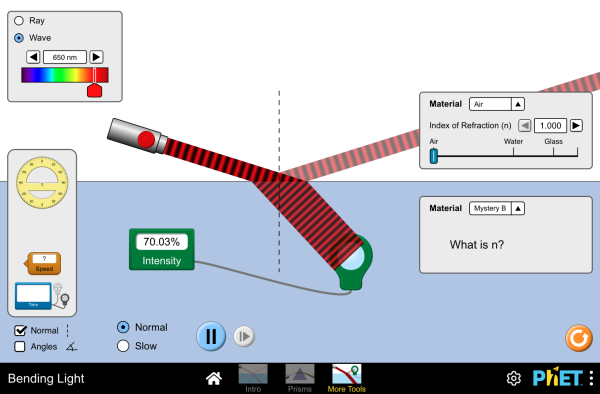
Bending Light
Explore bending of light between two media with different indices of refraction. See how changing from air to water to glass changes the bending angle. Play with prisms of different shapes and make rainbows.

Beta Decay
Build an atom in the nucleus, then fire it off and see what happens! Watch beta decay happen in real time. Observe how the nucleus changes when a neutron becomes a proton.

Blackbody Spectrum
How does the blackbody spectrum of the sun compare to visible light? Learn about the blackbody spectrum of the sun, a light bulb, an oven, and the earth. Adjust the temperature to see the wavelength and intensity of the spectrum change.
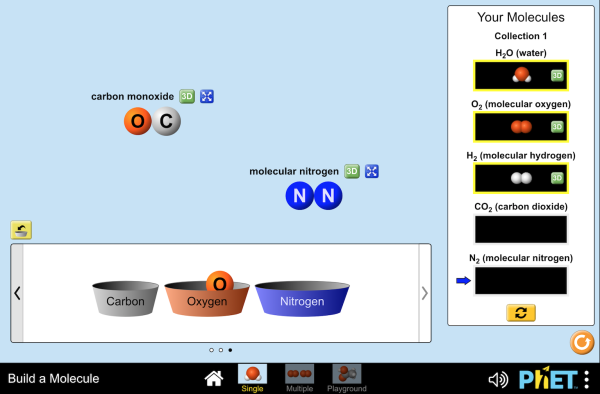
Build a Molecule
Starting from atoms, see how many molecules you can build. Collect your molecules and see them in 3D! How many can you collect?
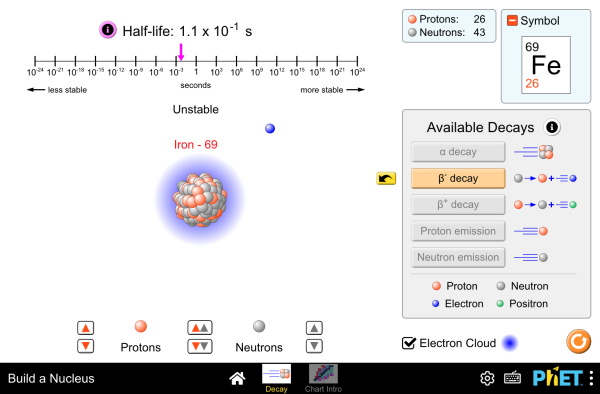
Build a Nucleus
Build an atom's nucleus by adding protons and neutrons. Discover which nuclei are stable and which are radioactive. Observe alpha and beta decay.
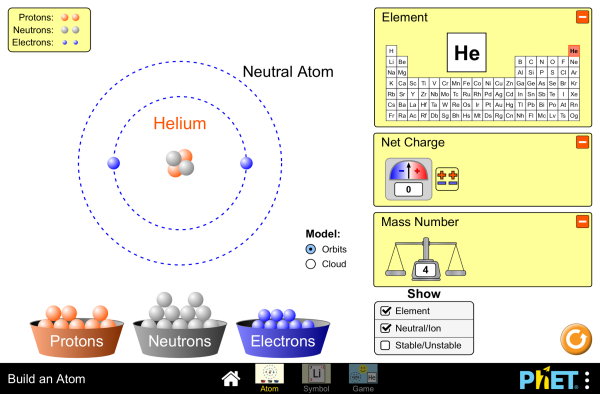
Build an Atom
Build an atom out of protons, neutrons, and electrons, and see how the element, charge, and mass change. Then play a game to test your ideas!
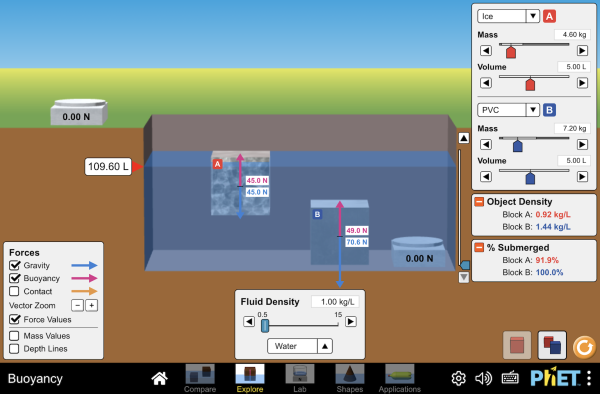
Buoyancy
When will objects float and when will they sink? Learn how buoyancy works with blocks of wood and other materials. Change the density of the fluid and observe the effects.
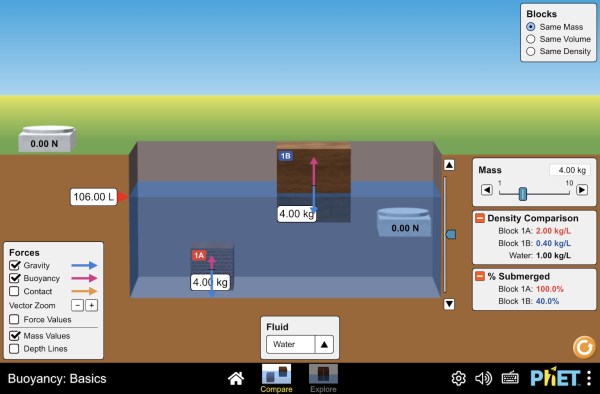
Buoyancy: Basics
Explore why objects float or sink in water. Discover how the density of an object and the fluid determines whether it floats.
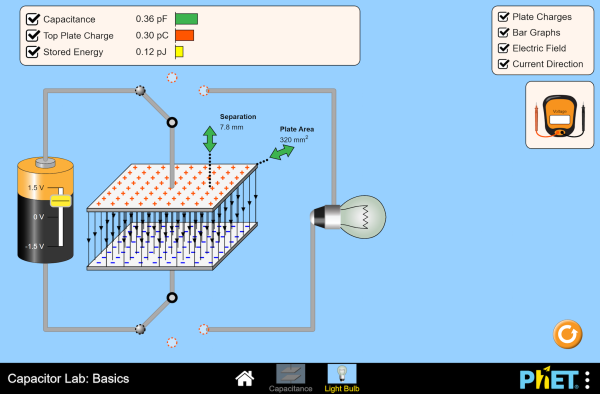
Capacitor Lab: Basics
Explore how a capacitor works! Change the size of the plates and add a dielectric to see how it affects capacitance. Connect a capacitor to a battery and observe the charge stored.

Cell Signaling
Explore how cells communicate with each other through chemical signals. Observe how a signal molecule binds to a receptor and triggers a cascade of events inside the cell.
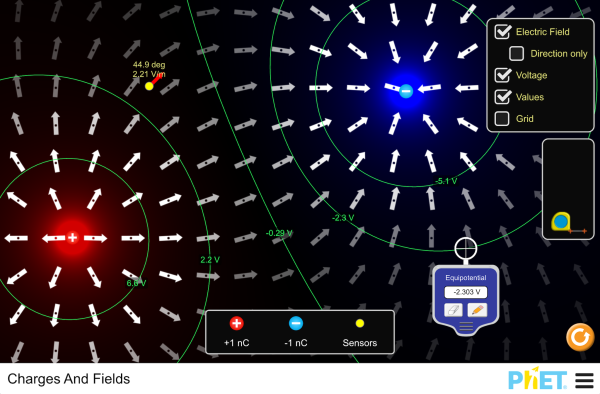
Charges and Fields
Arrange positive and negative charges in space and view the resulting electric field and electrostatic potential. Return charged particles to the toolbox and explore the relationship between charge, field, and potential.
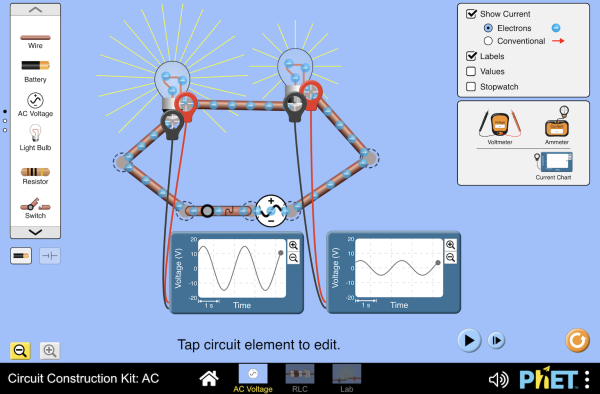
Circuit Construction Kit: AC
Build circuits with capacitors, inductors, resistors and AC or DC voltage sources. Explore the behavior of AC circuits and measure voltage and current with lab instruments.
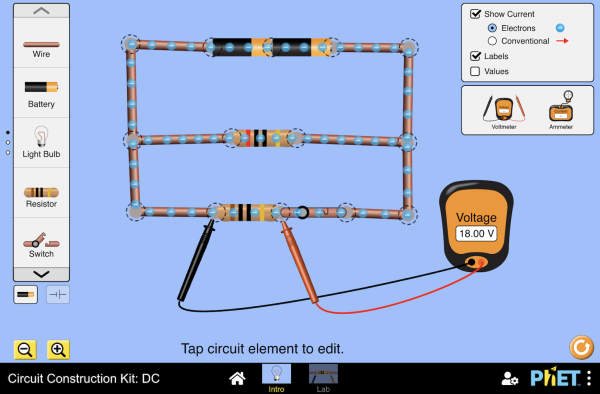
Circuit Construction Kit: DC
An electronics kit in your computer! Build circuits with resistors, light bulbs, batteries, and switches. Take measurements with the realistic ammeter and voltmeter. View the circuit as a schematic diagram.
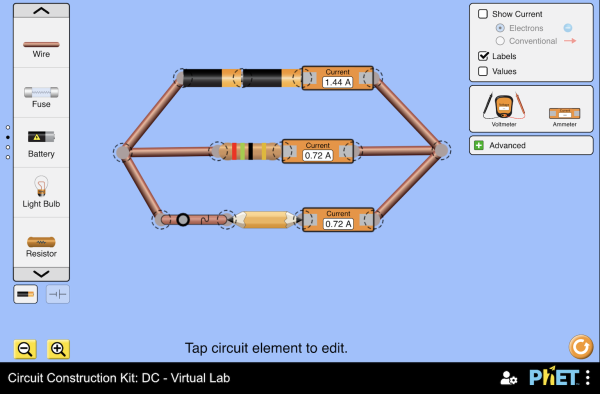
Circuit Construction Kit: DC - Virtual Lab
Build circuits with capacitors, inductors, resistors and AC or DC voltage sources, and inspect them using lab instruments such as voltmeters and ammeters.
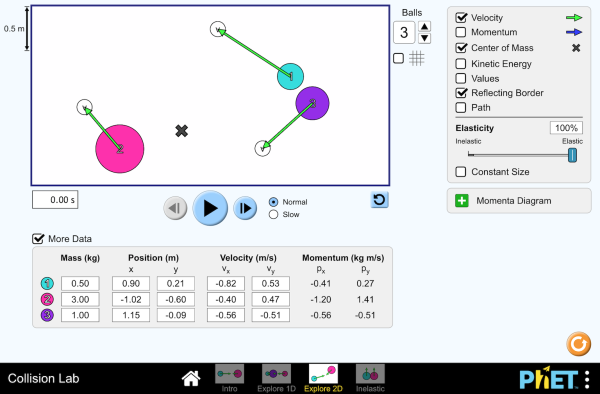
Collision Lab
Use an air hockey table to investigate simple collisions in 1D and more complex collisions in 2D. Experiment with the number of balls, masses, and initial conditions. Vary the elasticity and see how the total momentum and kinetic energy changes.
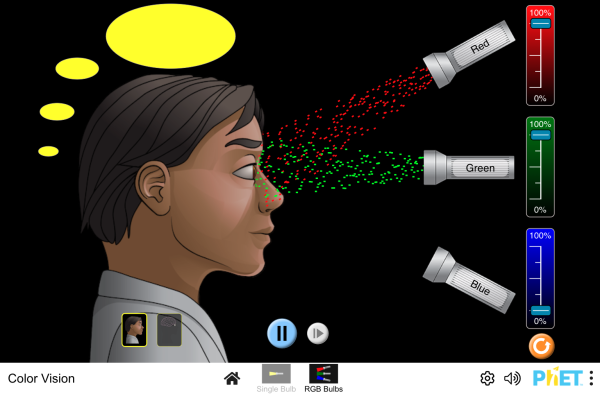
Color Vision
Make a whole rainbow by mixing red, green, and blue light. Change the wavelength of a monochromatic beam or filter white light. View the light as a solid beam, or see the individual photons.
Color Vision
Explore how the human eye perceives color. Learn about the three types of cone cells and how they respond to different wavelengths of light.
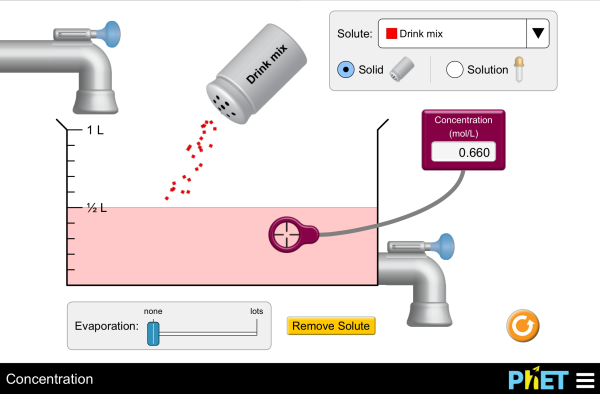
Concentration
Watch your solution change color as you mix chemicals with water. See how concentration changes with the amount of solute and solution volume. Calculate and display concentration in Molarity.
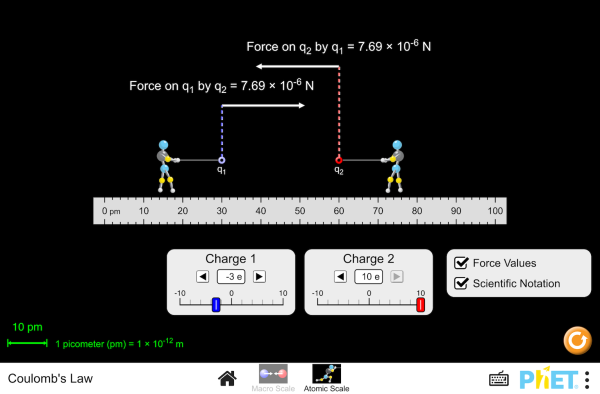
Coulomb's Law
Visualize the electrostatic force that two charges exert on each other. Observe how changing the sign and magnitude of the charges and the distance between them changes the electrostatic force.
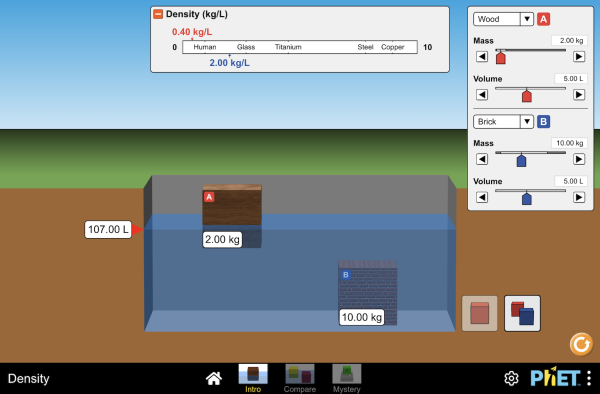
Density
Why do objects like wood float in water? Investigate the relationship between mass, volume, and density. Measure the volume of different objects and calculate their density.
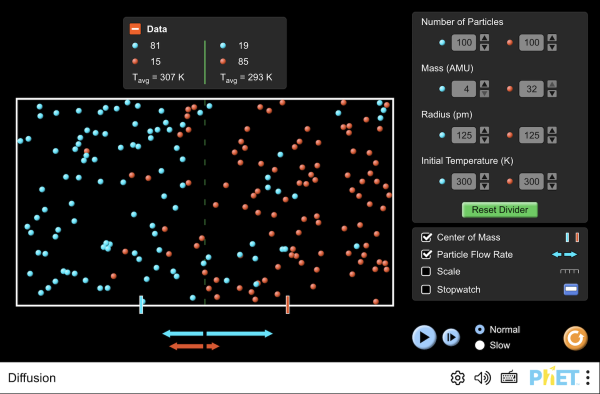
Diffusion
Explore diffusion by watching particles of two different gases mix. Observe how temperature, particle mass, and initial conditions affect the rate of diffusion.

Eating & Exercise
See how different foods and activities affect your body's energy balance. Explore the relationship between calories consumed and calories burned. Understand how metabolism works.
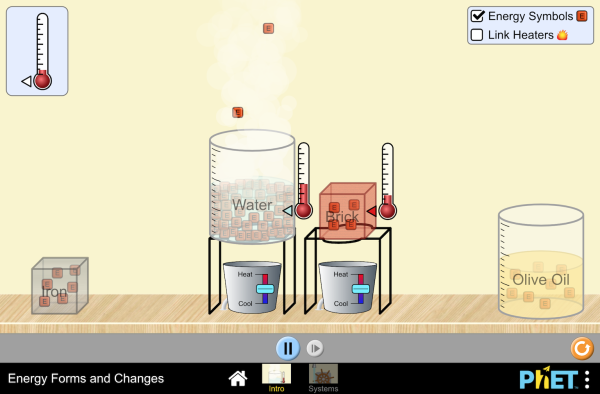
Energy Forms and Changes
Explore how energy can be converted from one form to another. Observe how energy flows through different systems and how it is transformed.
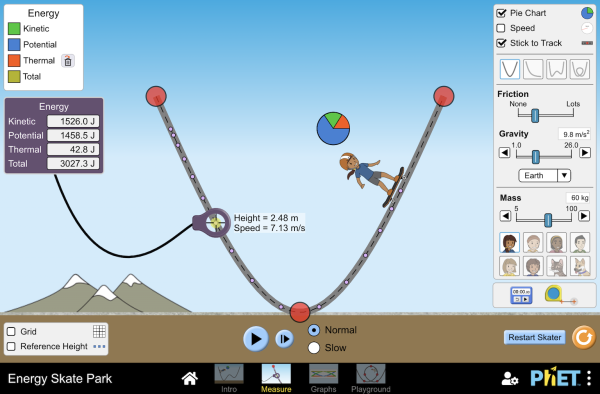
Energy Skate Park
Explore the conservation of energy with a skater on different tracks. Build custom tracks, measure speed and height, and investigate how friction affects the system.
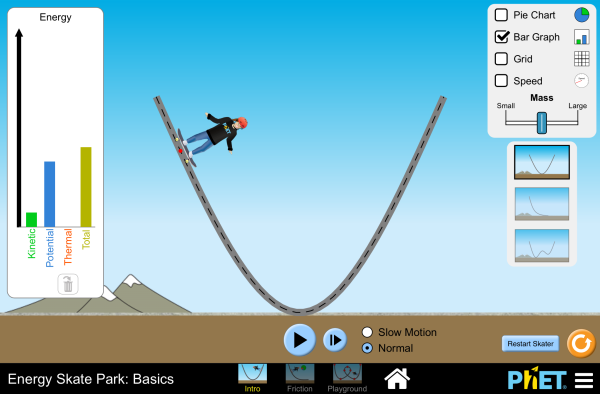
Energy Skate Park: Basics
Learn about conservation of energy with a skater dude! Explore different tracks and view the kinetic energy, potential energy and friction as he moves. Build your own tracks, ramps and jumps for the skater.
Epidemic Calculator
This calculator implements a classical infectious disease model — SEIR (Susceptible → Exposed → Infected → Removed), an idealized model of spread still used in frontlines of research e.g. [Wu, et. al, Kucharski et. al]. The dynamics of this model are characterized by a set of four ordinary differential equations that correspond to the stages of the disease's progression: individuals is 0.00088% given an attack rate of 0.45% [Burke et. al].
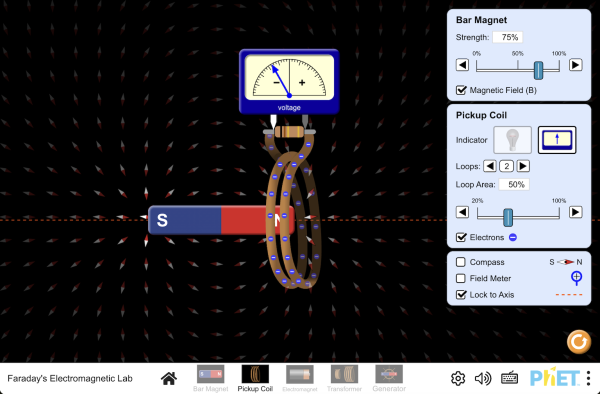
Faraday's Electromagnetic Lab
Play with a bar magnet and coils to learn about Faraday's law. Move a bar magnet near one or two coils to make a light bulb glow. View the magnetic field lines.
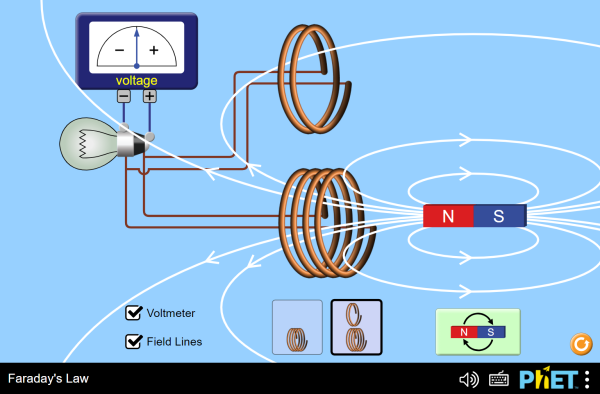
Faraday's Law
Explore Faraday's law by moving a bar magnet near a coil of wire. Observe how the induced EMF changes with the speed of the magnet and the number of coil loops.
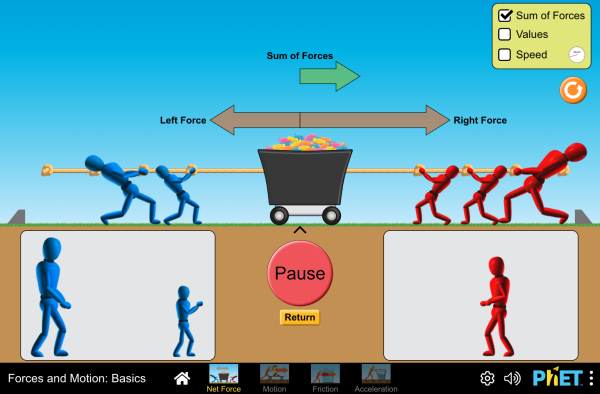
Forces and Motion: Basics
Explore the forces at work when pulling against a cart, and pushing a refrigerator, crate, or person. Create an applied force and see how it makes objects move. Change friction and see how it affects the motion of objects.
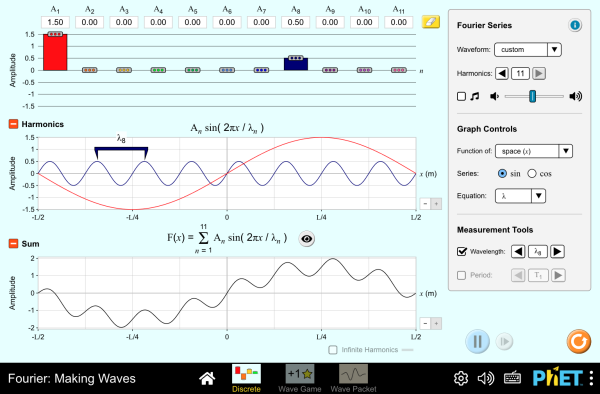
Fourier: Making Waves
Learn how to make waves of all different shapes by adding up sines or cosines. Make waves in space and time and measure their wavelengths and periods.
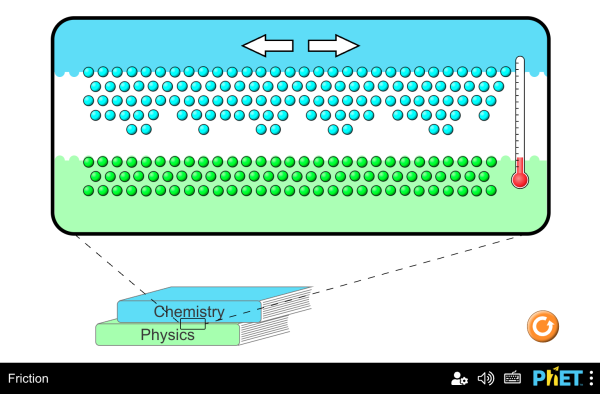
Friction
Explore the forces at work when you try to push a filing cabinet. Create an applied force and see how friction affects the motion. Observe how different surfaces affect friction.
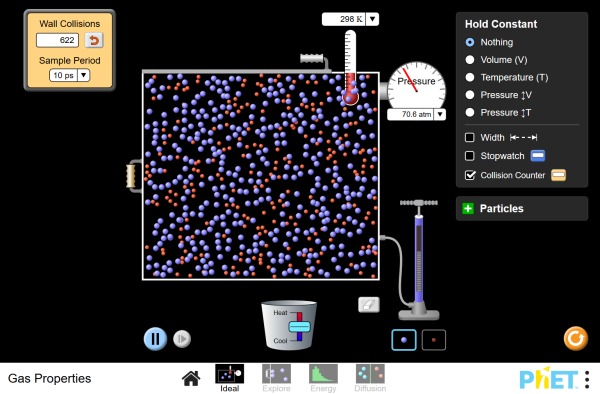
Gas Properties
Pump gas molecules to a box and see what happens as you change the volume, add or remove heat, and more. Measure the temperature and pressure, and discover how the properties of the gas vary in relation to each other.
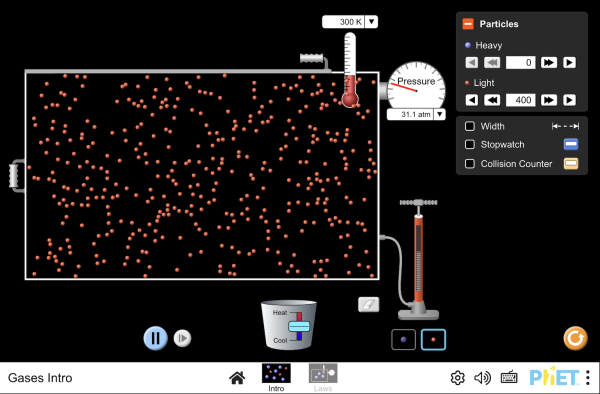
Gases Intro
Explore the properties of gases. Pump gas molecules into a box and observe how pressure, temperature, and volume are related.
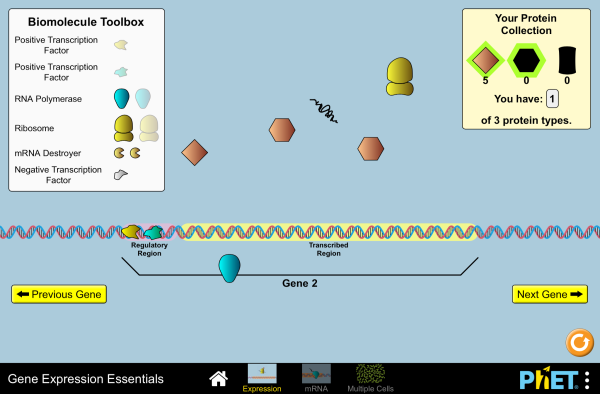
Gene Expression Essentials
Explore how genes are expressed to make proteins. Observe transcription (DNA to mRNA) and translation (mRNA to protein). See how transcription factors regulate gene expression.
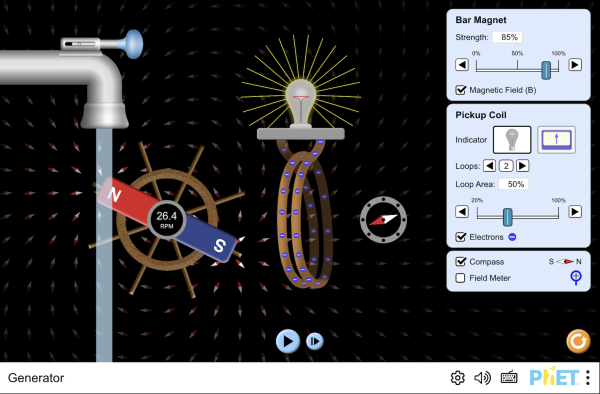
Generator
Generate electricity with a bar magnet! Discover the physics behind the phenomena by exploring magnets and how you can use them to make a bulb light.
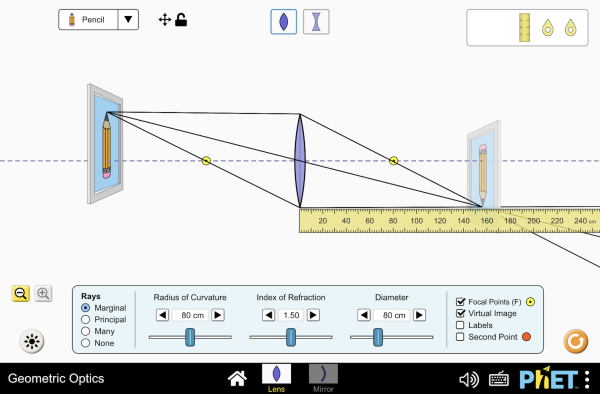
Geometric Optics
How does a lens form an image? See how light rays are refracted by a lens. Change the focal length of the lens and see how the image changes.

Geometric Optics: Basics
Explore how a lens forms an image. Observe how changing the focal length and object position affects the image formed by a converging lens.
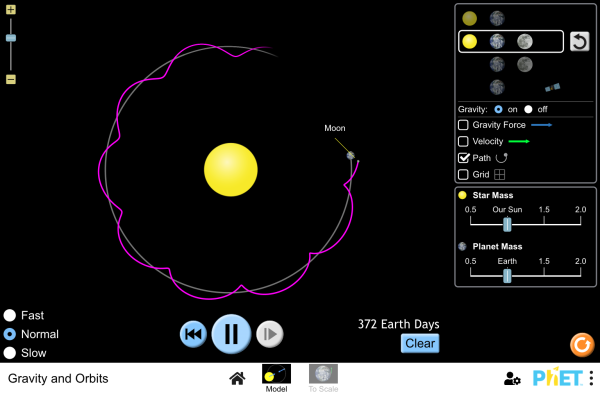
Gravity and Orbits
Move the sun, earth, moon and space station to see how it affects their gravitational forces and orbital paths. Visualize the sizes and distances between different heavenly bodies.
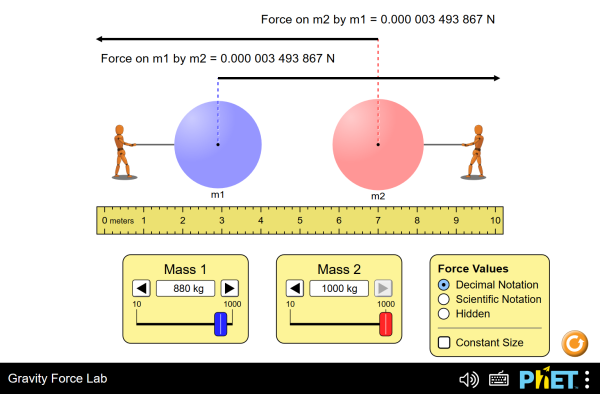
Gravity Force Lab
Visualize the gravitational force that two objects exert on each other. Adjust properties of the objects to see how changing the properties affects the gravitational attraction.
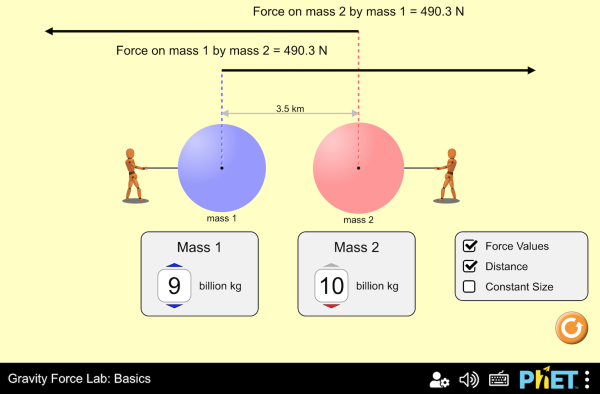
Gravity Force Lab: Basics
Visualize the gravitational force that two objects exert on each other. Change masses and distance to explore how gravity works.
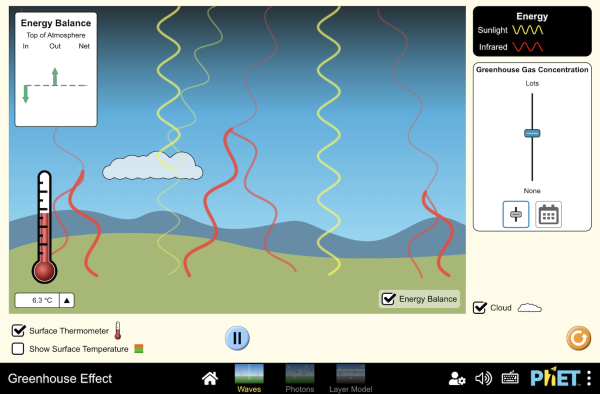
Greenhouse Effect
How do greenhouse gases affect the climate? Explore the effect of greenhouse gases on the temperature of the earth. Adjust the concentration of greenhouse gases and observe the effect on temperature.
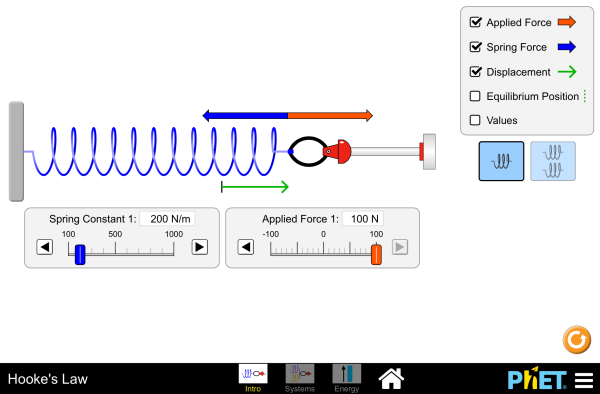
Hooke's Law
Stretch and compress springs to explore the relationships between force, spring constant, displacement, and stored energy. Investigate what happens when two springs are connected in series and parallel.
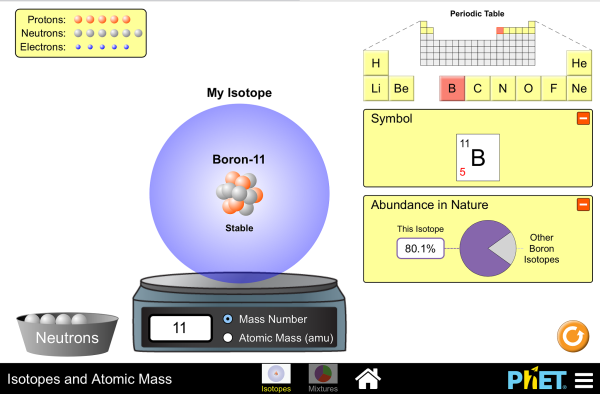
Isotopes and Atomic Mass
Are all atoms of an element the same? How do atoms of the same element differ? Explore the concept of isotopes by building atoms with different numbers of neutrons.
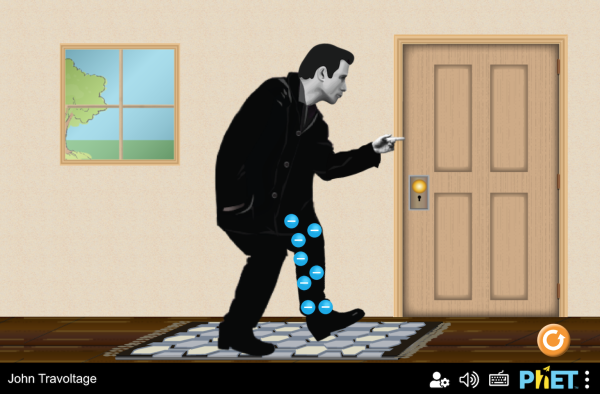
John Travoltage
Make sparks fly with John Travoltage! Rub John's foot on the carpet to build up static charge, then bring his hand near the door knob to see a spark.
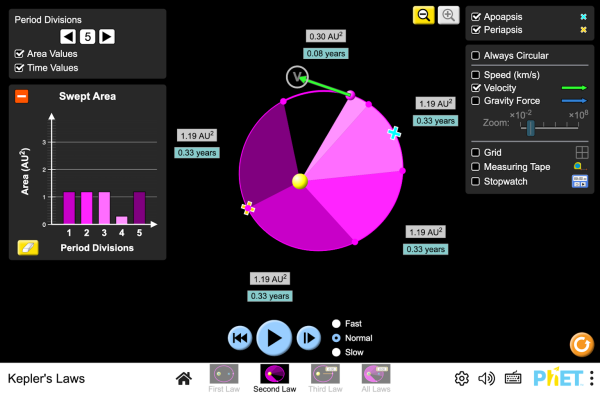
Kepler's Laws
Visualize the first, second, and third laws of planetary motion. Explore how orbital eccentricity, period, and semi-major axis are related.
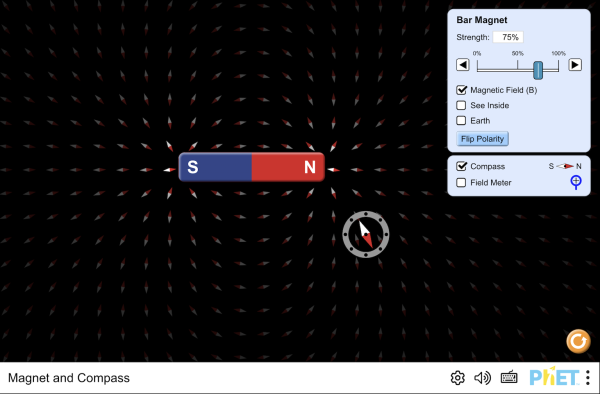
Magnet and Compass
Ever wonder how a compass works? Explore the interactions between a compass and bar magnet, and then add the Earth and find the relationship between the Earth and a compass.
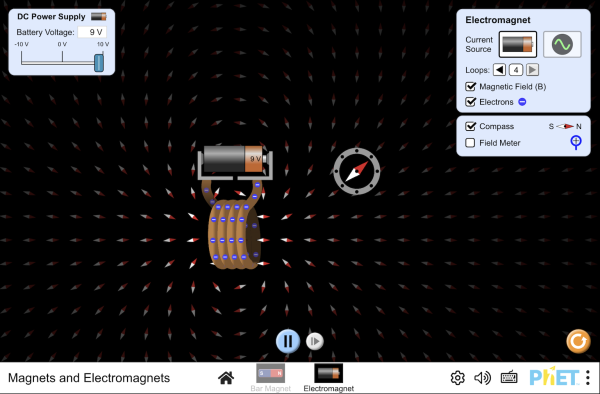
Magnets and Electromagnets
Explore the similarities and differences between permanent magnets and electromagnets. Discover how an electric current creates a magnetic field.
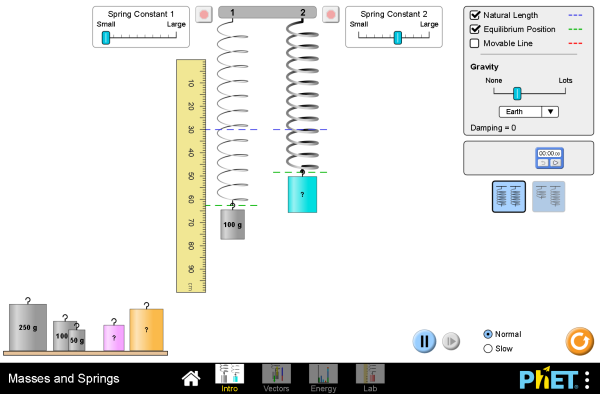
Masses and Springs
A realistic mass and spring laboratory. Hang masses from springs and adjust the spring stiffness and damping. You can even slow time. Transport the lab to different planets.
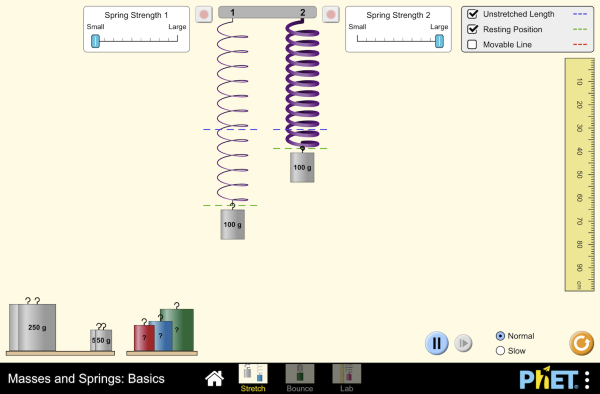
Masses and Springs: Basics
Hang masses from springs and discover how they stretch and bounce. Explore the relationship between spring force and stretch distance.

Membrane Channels
Explore how molecules move across the cell membrane through channels and pumps. Observe passive transport (diffusion) and active transport. See how concentration gradients drive molecular movement.
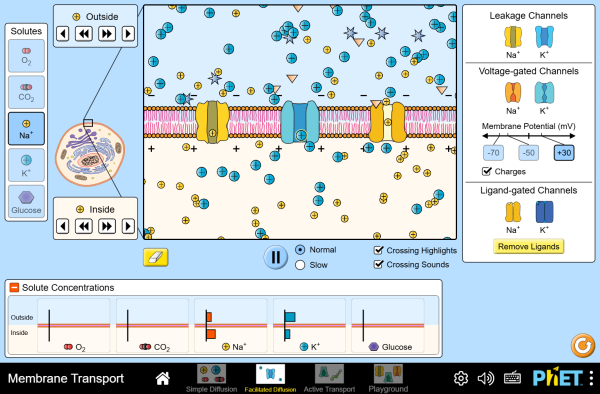
Membrane Transport
Explore how molecules move across cell membranes. Investigate passive transport (diffusion and osmosis) and active transport. See how membrane proteins facilitate transport.

Models of the Hydrogen Atom
How did scientists figure out the structure of atoms without looking at them? Try out different models by shooting light at the atom. Check how the prediction of the model matches the experimental results.
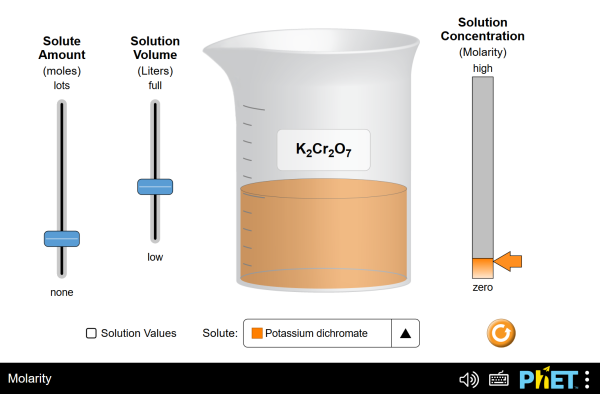
Molarity
What determines the concentration of a solution? Learn about concentration, molarity, and the factors that affect it. Observe how adding solute and changing volume affects molarity.
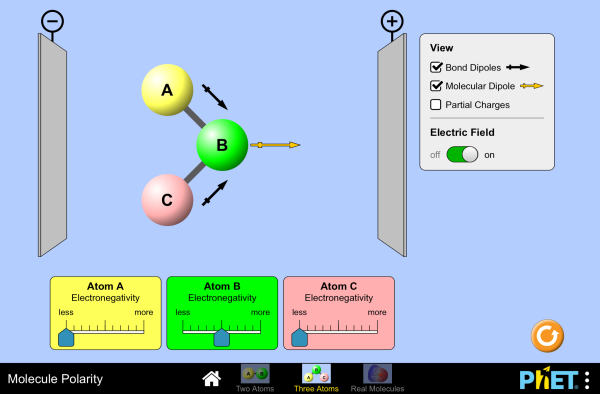
Molecule Polarity
When is a molecule polar? Explore electronegativity and molecular polarity. Adjust the electronegativity of atoms in a molecule and see how it affects the bond dipoles and molecular dipole.
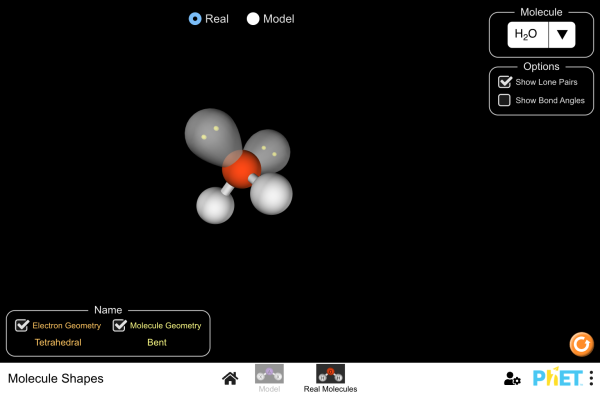
Molecule Shapes
Explore molecule shapes by building molecules in 3D! How does molecule shape change with different numbers of bonds and lone pairs? Find out by adding single, double or triple bonds and lone pairs to the central atom.

Molecule Shapes: Basics
Explore molecule shapes in 3D. Build simple molecules and observe how the number of bonds and lone pairs determines the shape.
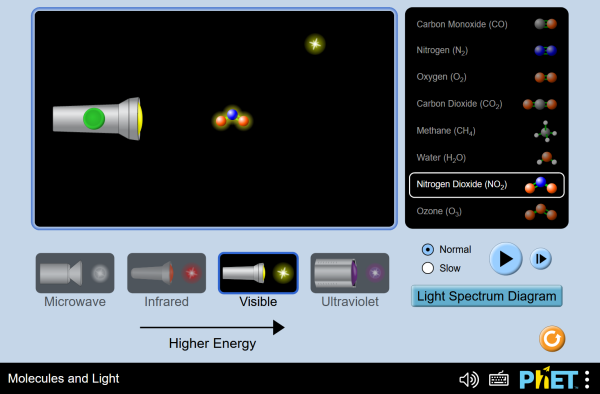
Molecules and Light
Do you ever wonder how a greenhouse gas traps heat from the sun? Explore how light interacts with molecules in our atmosphere. Start with the basics and then see how light interacts with ozone, oxygen, and other atmospheric molecules.
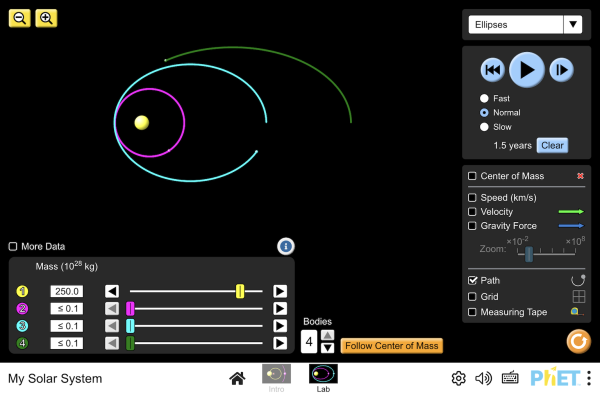
My Solar System
Build your own system of heavenly bodies and watch the gravitational ballet. With this orbit simulator, you can set initial positions, velocities, and masses of 2, 3, or 4 bodies, and see them orbit each other.
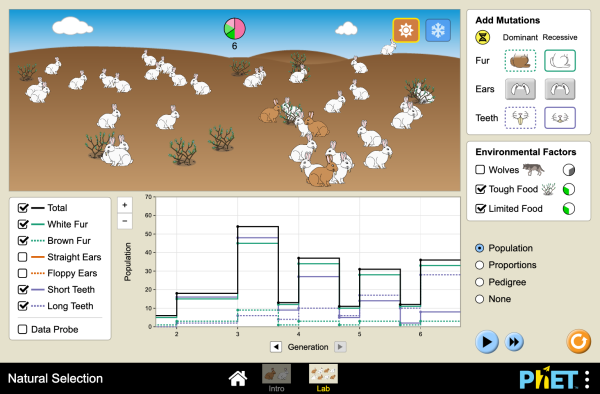
Natural Selection
Watch the bunnies multiply, adapt, and evolve! Add wolves and see how the population changes. Introduce mutations and see which traits are selected for or against.
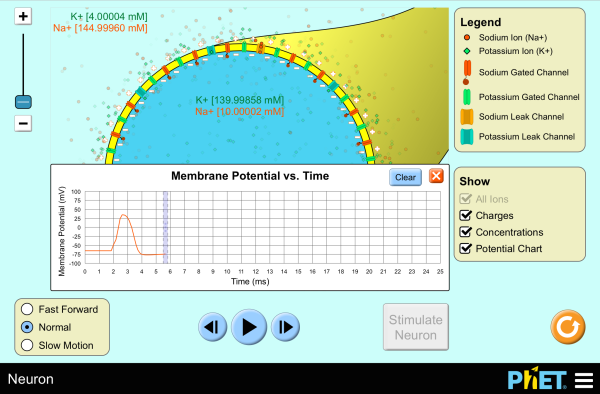
Neuron
Stimulate a neuron and see how it fires an action potential. Explore how the action potential travels along the axon. Learn about the role of ion channels in nerve signaling.
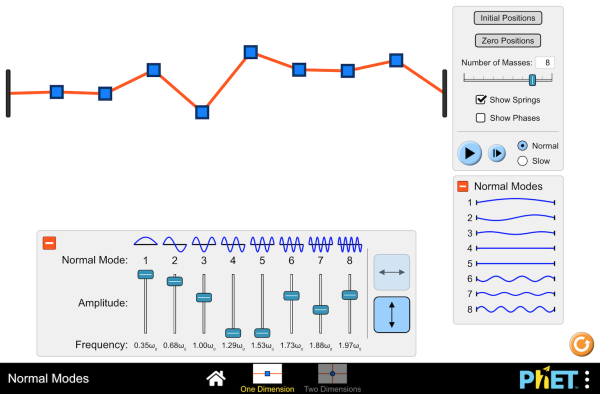
Normal Modes
Play with a 1D system of masses connected by springs. Observe the normal modes of oscillation and see how they combine to create complex motion.

Nuclear Fission
Start a chain reaction, or introduce non-radioactive isotopes to prevent one. Control energy production in a nuclear reactor!
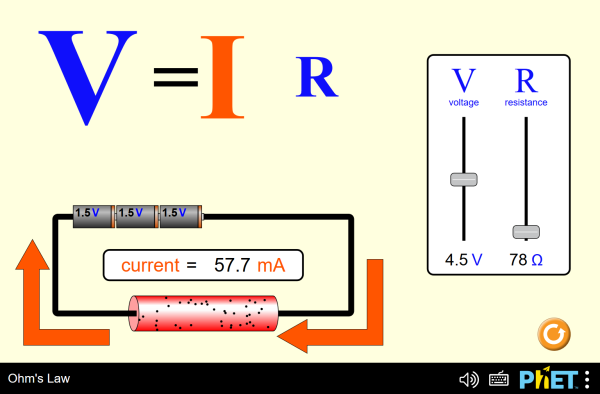
Ohm's Law
See how the equation form of Ohm's law relates to a simple circuit. Adjust the voltage and resistance, and see the current change according to Ohm's law.
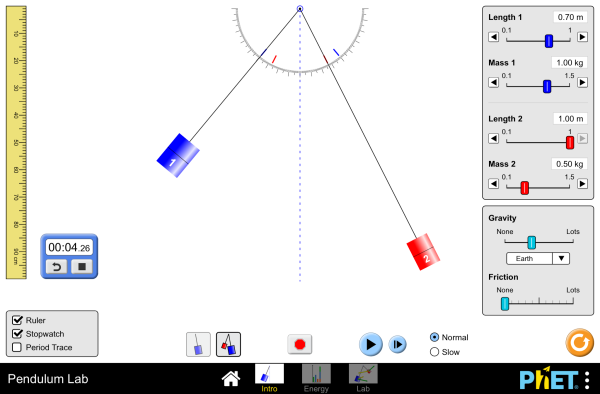
Pendulum Lab
Play with one or two pendulums and discover how the period of a simple pendulum depends on the length of the string, the mass of the pendulum bob, the strength of gravity, and the amplitude of the swing.
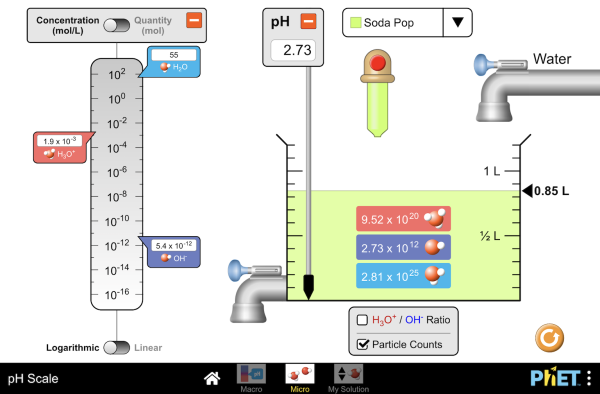
pH Scale
Test the pH of things like coffee, spit, and soap to determine whether each is acidic, basic, or neutral. Visualize the relative number of hydroxide ions and hydronium ions in solution.
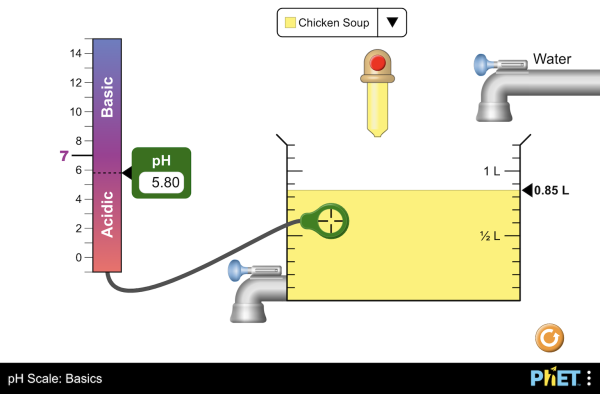
pH Scale: Basics
Test the pH of everyday liquids such as coffee, spit, and soap to determine whether each is acidic, basic, or neutral. Visualize the relative number of hydroxide ions and hydronium ions in solution.

Photoelectric Effect
See how light knocks electrons off a metal target, and recreate the experiment that spawned the field of quantum mechanics. Observe the photoelectric effect experiment and understand Einstein's explanation.
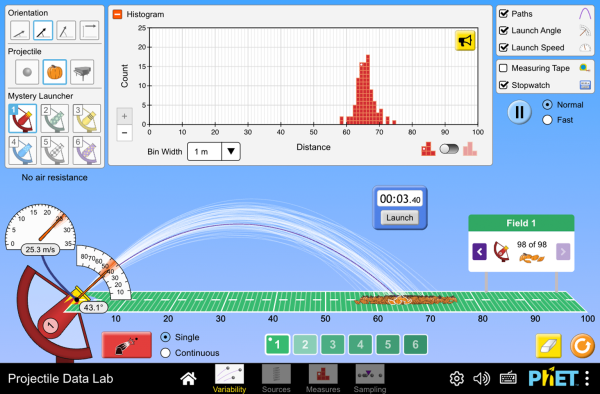
Projectile Data Lab
Investigate projectile motion through data collection and analysis. Launch projectiles, collect data, and use statistical analysis to understand the relationships between launch parameters and landing position.
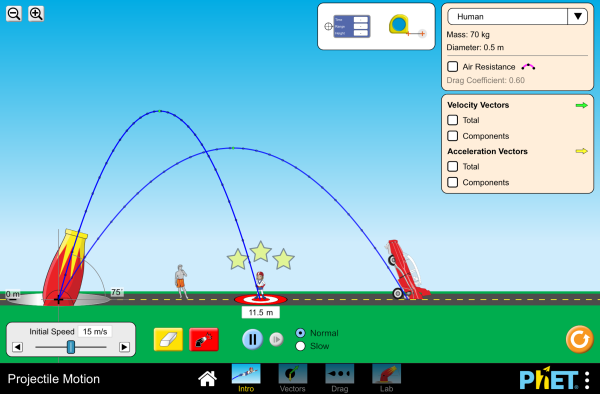
Projectile Motion
Blast a Buick out of a cannon! Learn about projectile motion by firing various objects. Set the angle, initial speed, and mass. Add air resistance. Make a game out of this simulation by trying to hit a target.

Protein Synthesis
Explore the process of protein synthesis in detail. Watch how ribosomes read the mRNA sequence and assemble amino acids into a polypeptide chain. Understand the genetic code and codon-anticodon interactions.

Quantum Bound States
Explore the quantum mechanical model of bound states. Observe wave functions, energy levels, and probability densities for particles in various potential wells.
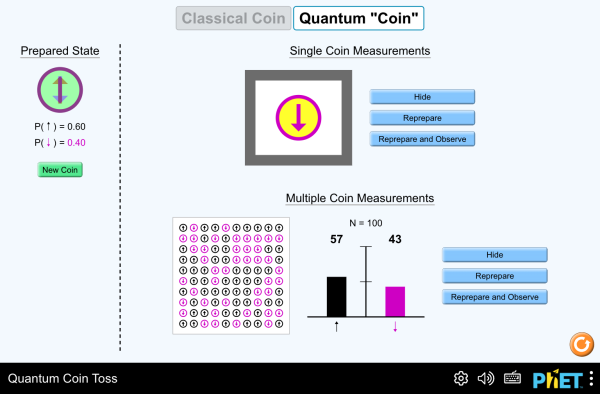
Quantum Coin Toss
Explore the difference between classical and quantum probability. Compare a classical coin flip to a quantum coin toss and observe the fundamental differences.
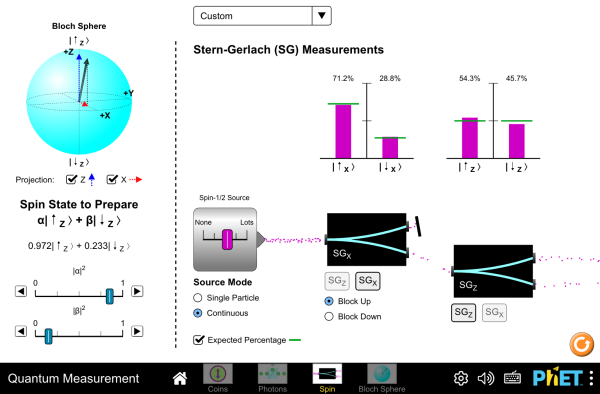
Quantum Measurement
Explore the quantum measurement problem. Observe how measuring a quantum system affects its state and investigate the role of the observer in quantum mechanics.

Radioactive Dating Game
Learn about different types of radiometric dating, such as carbon dating. Understand how decay and half life work to enable radiometric dating. Play a game that tests your ability to match the percentage of the dating element that remains to the age of the object.
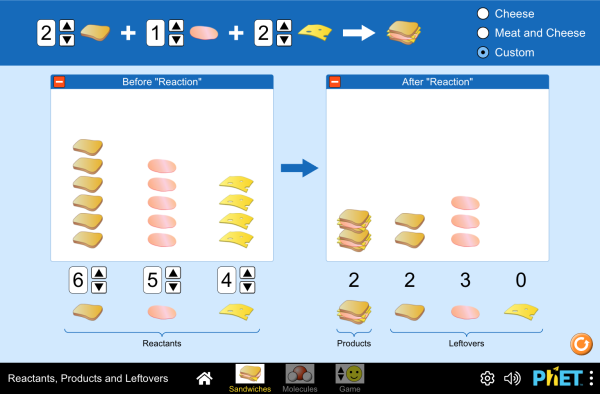
Reactants, Products and Leftovers
Create your own sandwich and then see how many sandwiches you can make with the ingredients you have. Apply the same concept to chemical reactions.

Reactions and Rates
Explore what makes a reaction happen by colliding atoms and molecules. Design experiments that show how factors like concentration, temperature, and surface area affect reaction rates.
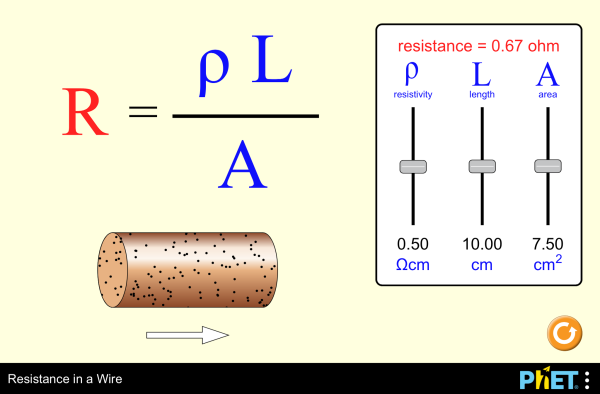
Resistance in a Wire
Observe changes to the equation and wire as you play with the resistivity, length, and area of the wire. Deduce the relationship between resistance, resistivity, length, and cross-sectional area.
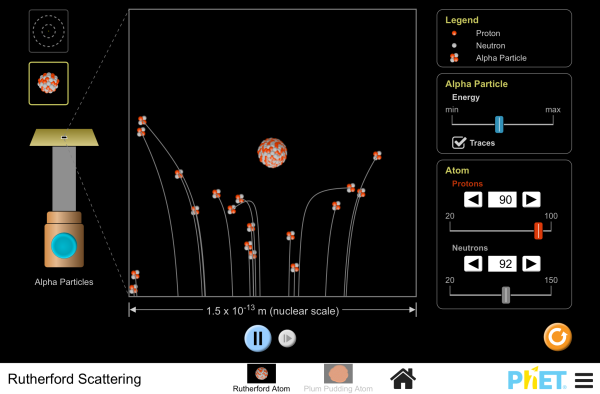
Rutherford Scattering
How did Rutherford figure out the structure of the atom without being able to see it? Simulate the famous Rutherford Gold Foil Experiment and observe how alpha particles scatter off nuclei.

Sound
Explore the relationship between the properties of sound waves and how we perceive them. Hear the sound produced by the speaker, and see the sound waves. Adjust the frequency and amplitude of the sound.

Sound Waves
Explore how sound waves are produced and how they travel through different media. Visualize the compressions and rarefactions of a longitudinal wave.
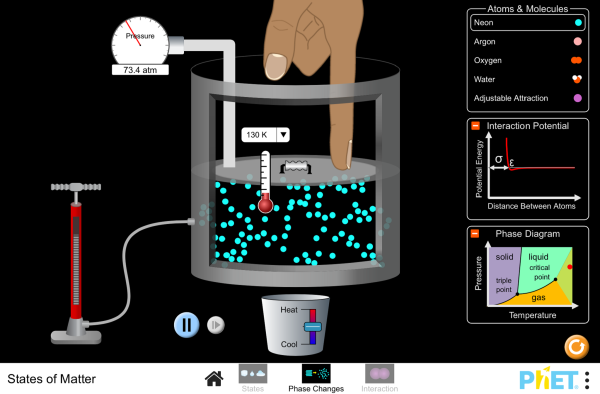
States of Matter
Watch different types of molecules form a solid, liquid, or gas. Add or remove heat and watch the phase change. Change the temperature or volume of a container and see a pressure-temperature diagram respond in real time.
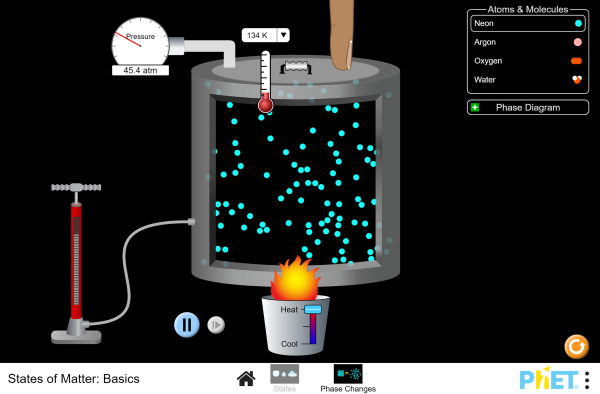
States of Matter: Basics
Heat, cool, and compress atoms and molecules and watch as they change between solid, liquid, and gas phases.

Sugar and Salt Solutions
Add different salts or alcohols to water, then watch them dissolve and see a diagram of the resulting solution. Determine if a substance is a strong or weak electrolyte by measuring the conductivity.
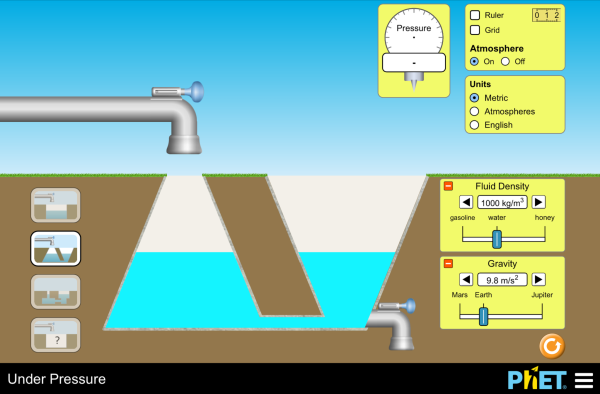
Under Pressure
Explore pressure in the atmosphere and underwater. Reshape a container of fluid. Discover how pressure changes as you move to different depths in the fluid.
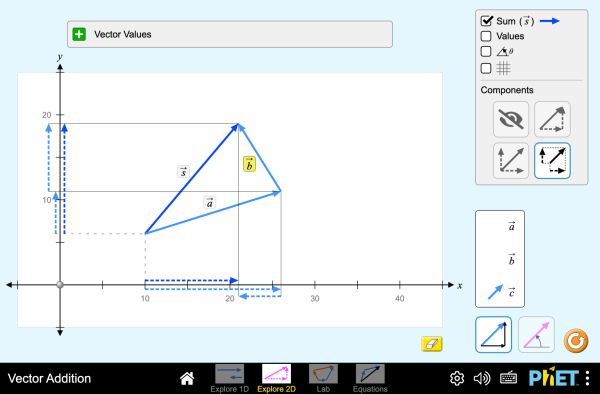
Vector Addition
Learn how to add vectors. Drag vectors onto a graph, change their length and angle, and sum them together. The magnitude, angle, and components of each vector can be displayed in several formats.
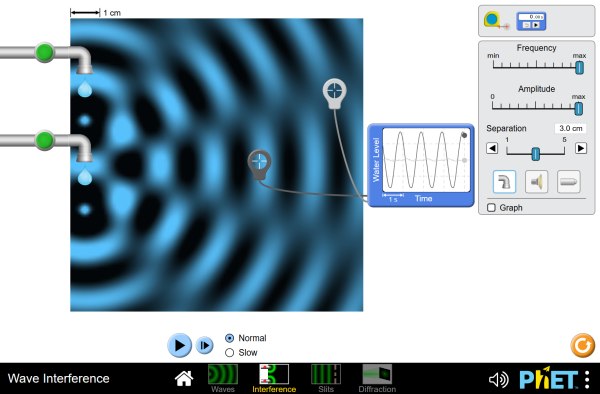
Wave Interference
Make waves with a dripping faucet, audio speaker, or laser! Add a second source or a pair of slits to create an interference pattern. Measure the wavelength, frequency, and speed of the waves.
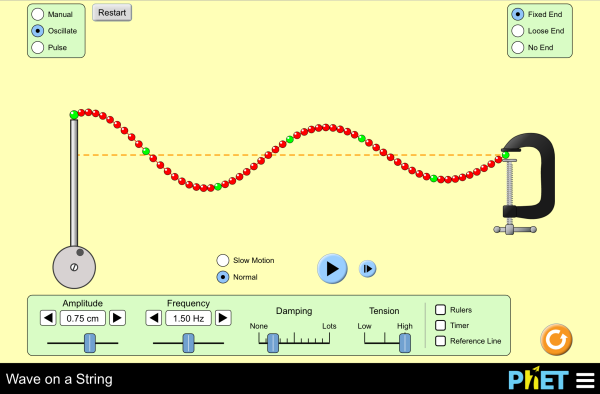
Wave on a String
Explore the wonderful world of waves! Wiggle the end of the string and make waves, or adjust the frequency and amplitude of an oscillator. Observe a string vibrate in slow motion.

Wave Packets
Explore the wave-particle duality of quantum mechanics. Build wave packets from superpositions of plane waves and observe the uncertainty principle in action.
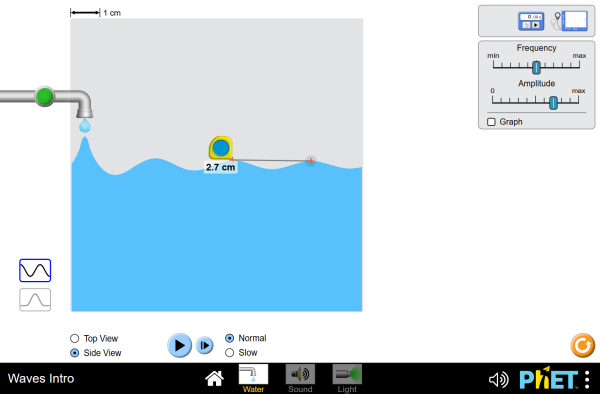
Waves Intro
Make waves with a dripping faucet, audio speaker, or laser! Adjust frequency and amplitude, and observe the effects. Measure the wavelength, period, frequency, and wave speed.